News & Blog
Jump to: Latest News, Most Popular, Slothopedia, Sloth Research, Project Updates, Tales From The Jungle, Sloth Verus, Tracking Diaries, Community-Based Conservation, Threats To Sloths And Their Jungle Home, How To Help Sloths, Paleo Sloths, Sloth Fun, Responsible Tourism, Sloth Friendly Living, SloCo Team, News

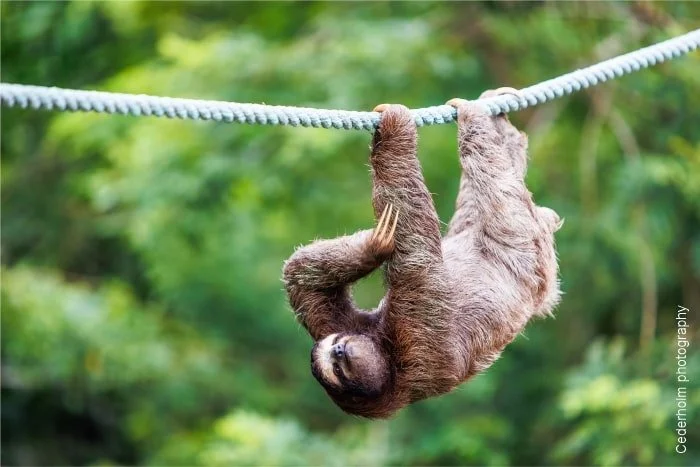
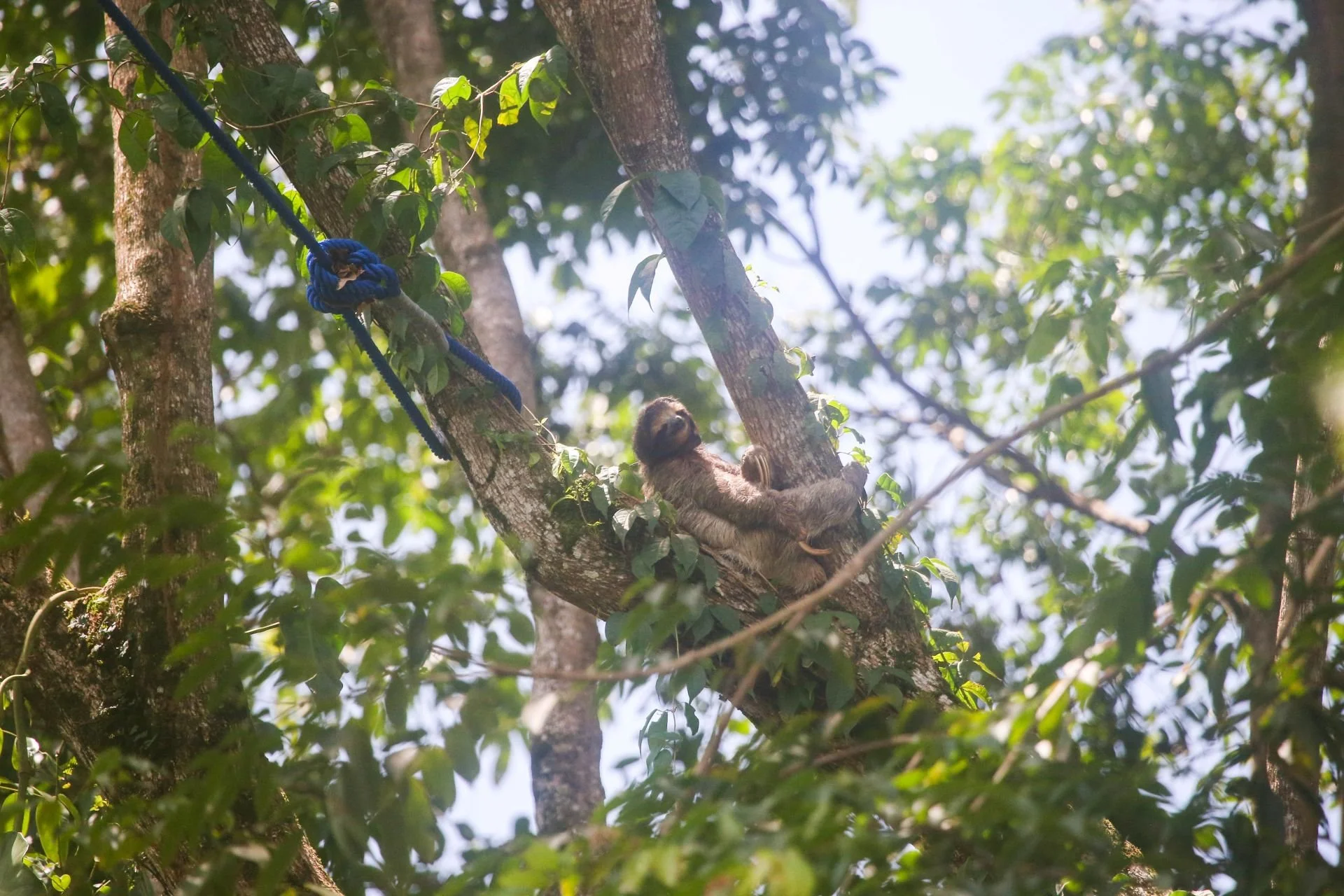
A study investigated how sloths and other mammals use rope bridges in Costa Rica. After monitoring 61 bridges and recording more than 3,000 crossings, the findings offer valuable insights into restoring forest connectivity and protecting wildlife.
Our most emotional SLOTHtober yet! From introducing the historic SLOTHS Act in the U.S. Congress to celebrating the International Sloth Festival, and a very special honour.
This recognition follows an Honorary Doctor of Science from Swansea University, a Future For Nature Award, and international recognition for The Sloth Conservation Foundation's work protecting wild sloths and their habitats.
Three days of wildlife conservation, music, art, and community at the 3rd International Sloth Festival in Puerto Viejo, Costa Rica.
The Sloth Protection Alliance helped develop a bipartisan bill to end wild-caught sloth imports into the United States. Here is what the SLOTHS Act would change, why it matters, and how you can help it become law.
The Sloth Protection Alliance announces the introduction of the bipartisan SLOTHS Act in the U.S. House of Representatives.
A difficult month for our research team, progress for sloth protection, and plenty happening as we get ready for Slothtober. Here’s what September brought for Team Sloth.
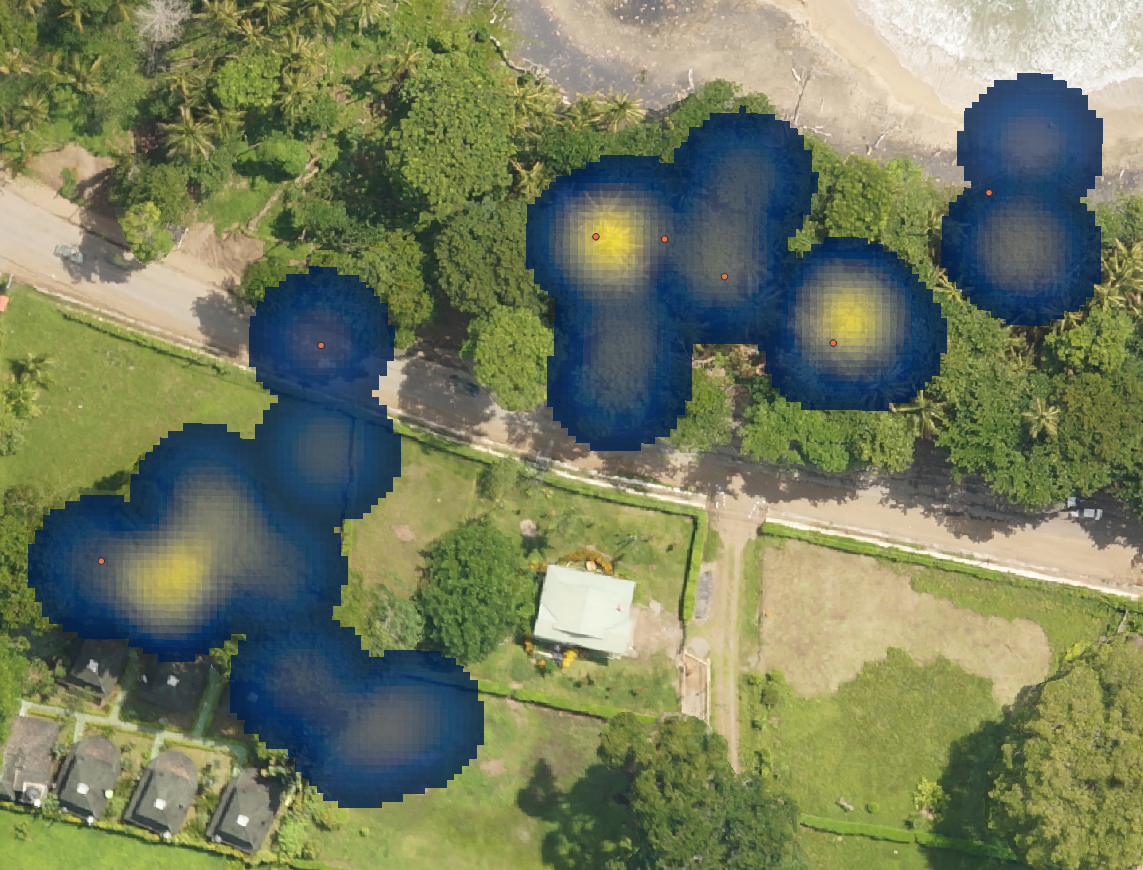
We're still in the middle of the Urban Sloth Project, but we wanted to share what the data is showing so far.
Sloths are more than fascinating rainforest animals. They have become symbols of strength, hope, and resilience for people around the world.
Florida is proposing new rules for sloths following the Sloth World Orlando tragedy. We break down what FWC is proposing, what we support, what is still missing, and how you can have your say.
August brought rain, rescues, good news, hard news, and plenty of reasons to keep going.
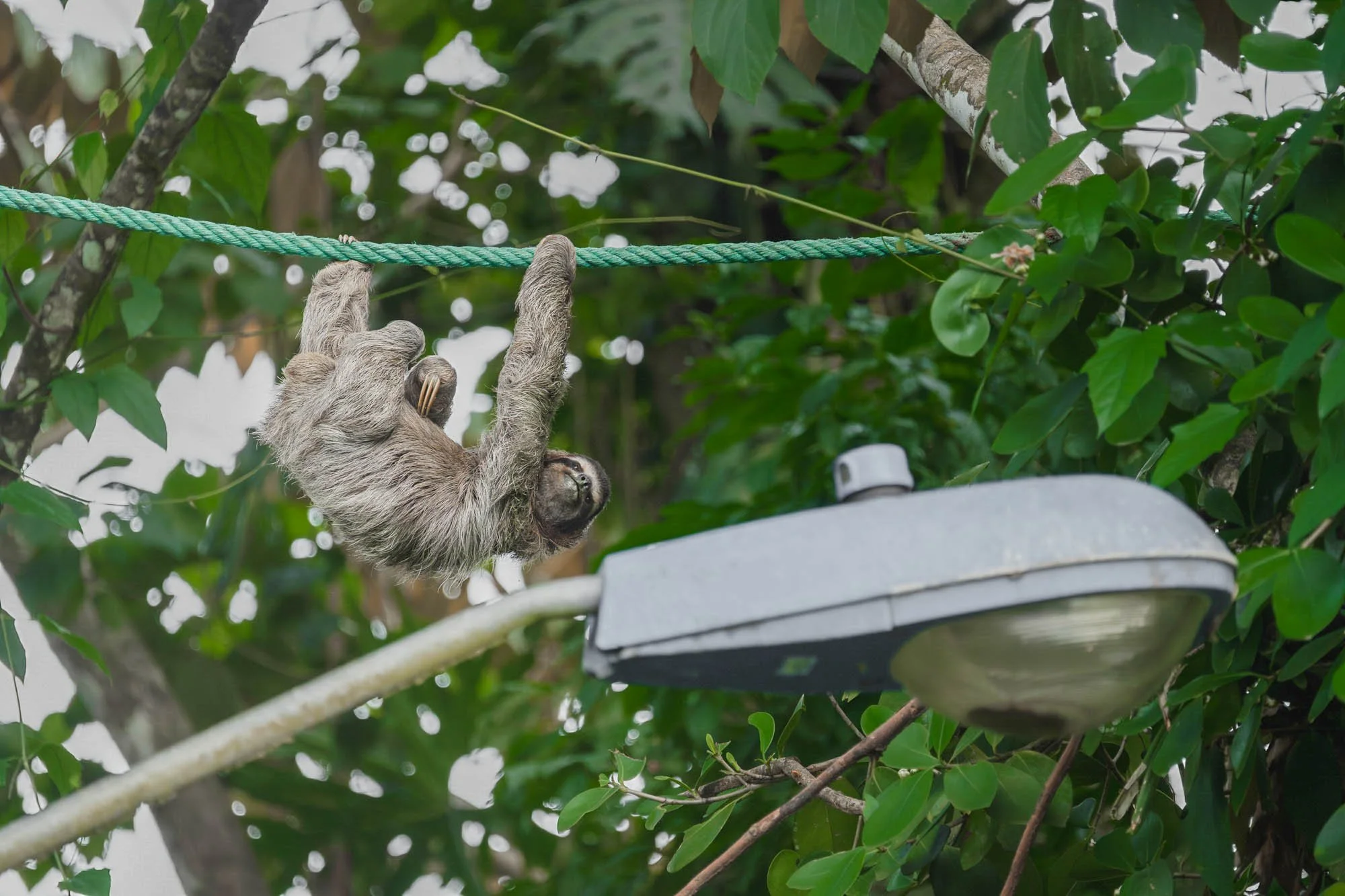
Martita's GPS data proved a road crossing was dangerous for sloths. Now there's a canopy bridge there and howler monkeys used it within 24 hours.
Somehow, we have made it to the end of 2025, and what a year it has been. Before everything speeds up again, I wanted to look back at what we have achieved together this year.
February flew by in a blur of new sloths, record-breaking census days, and even a little Italian TV fame! But before we dive headfirst into March, let’s take a moment to look back at all the jungle excitement.
Occasionally, sloths have been known to give birth to twins. Since there is only enough room on the female’s chest for one baby, and the sloth’s very slow metabolism only provides enough resources for one, the weakest twin will usually be rejected and abandoned.
Are sloths drinking more water than before? Is the smoke from cars affecting the delicate micro-ecosystems of green algae and moths that sloths have in their fur? Are sloths affected by artificial lights?
Nacho, a feisty Hoffmann’s two-fingered Sloth, joined the Urban Sloth Project in May 2021. Nacho was one of the most interesting sloths we monitored during the months he was part of the project.
Mangroves are vital for sloths, from the pygmy sloths of Panama to wild sloths drinking water in Costa Rica.
Discover the leading hypotheses behind sloth placentophagy and why this rarely observed behavior may help mothers protect and recover after birth.
Vanderhoeven, E.A., Florida, M., Cliffe, R.N., Guzmán, J., Notarnicola, J. and Kartzinel, T.R., 2025. Host specificity of gastrointestinal parasites in free-ranging sloths from Costa Rica. PeerJ, 13, p.e19408.
Last week, something truly extraordinary happened in the South Caribbean of Costa Rica: a three-fingered sloth baby with leucism was spotted! This is the first case ever recorded of its kind.
Contrary to the news reports, the virus in question, referred to as a “sloth virus,” is not exclusive to sloths.
We're still in the middle of the Urban Sloth Project, but we wanted to share what the data is showing so far.
Martita's GPS data proved a road crossing was dangerous for sloths. Now there's a canopy bridge there and howler monkeys used it within 24 hours.
A new study published may finally provide some clues.
When we think about the loss of forests, we usually imagine clear-cut deforestation. But across Latin America, another kind of forest loss is also happening…
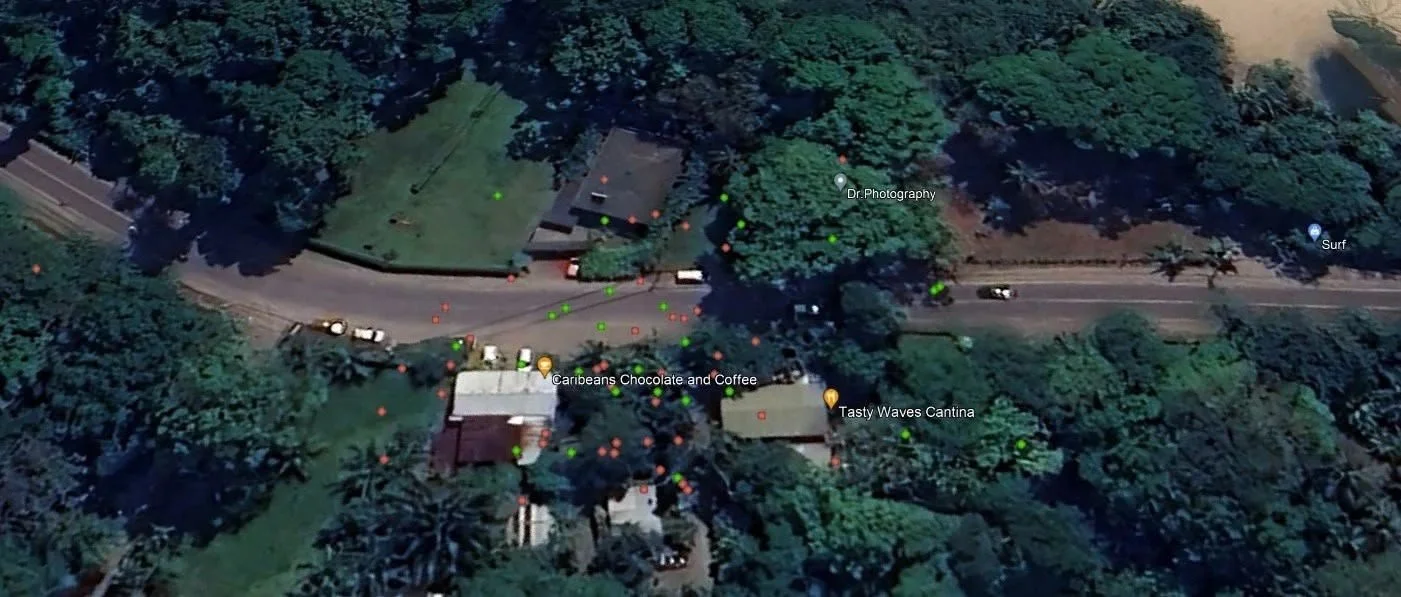
From the trees above a busy beach cantina to the edges of the urban forest, Tender’s life gave us a rare glimpse into how sloths grow, move, and adapt in human-shaped landscapes. This is the story of a gentle sloth, the community that surrounded him, and the lessons he left behind.
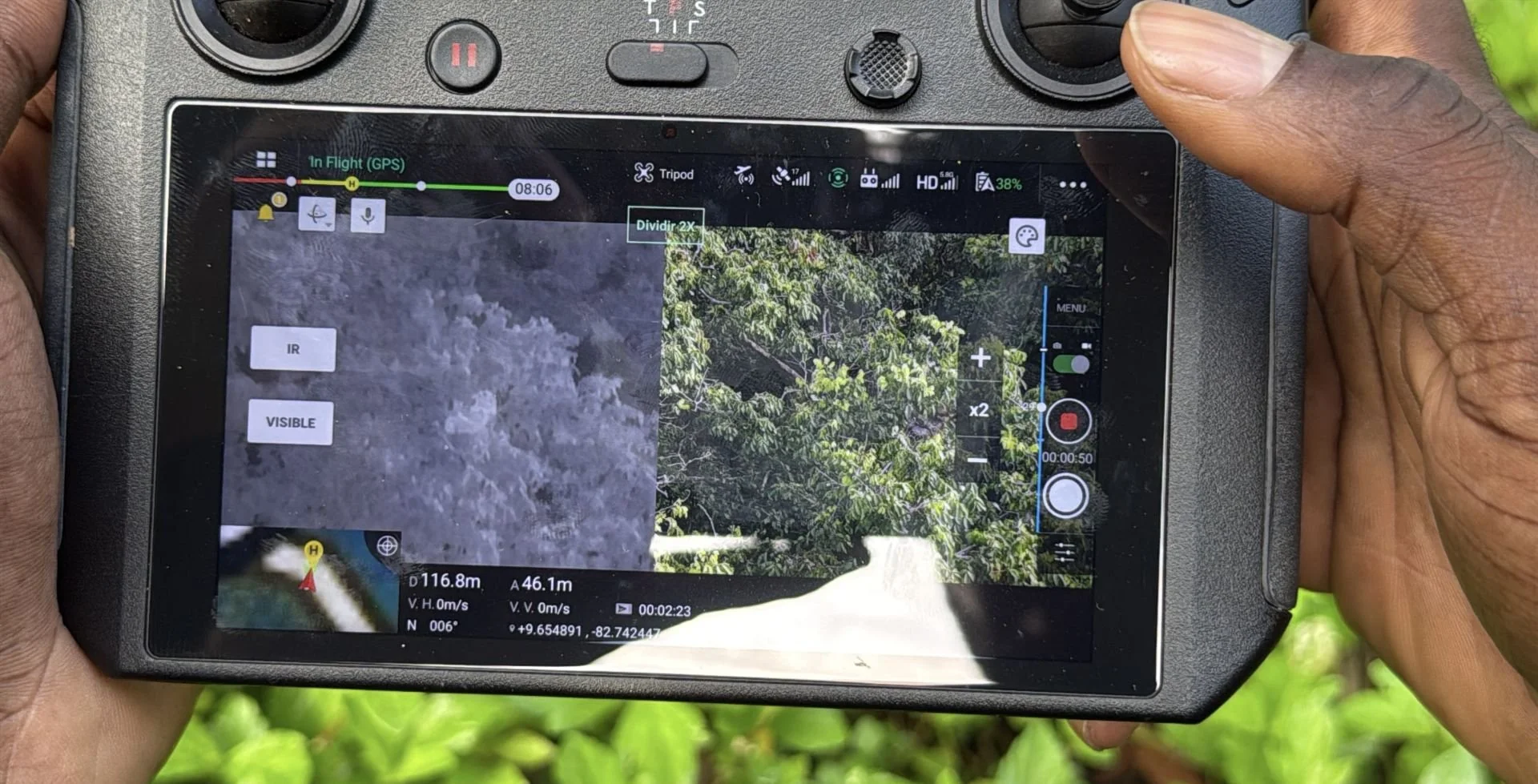
Trying to count sloths in a rainforest is quite hard: they move slowly, blend perfectly with the leaves, and spend their days tucked high in the canopy. But now, technology is giving conservationists and researchers a powerful new ally: drones that can see heat.
If there’s one thing fieldwork teaches you, it’s that nothing ever goes entirely to plan, and that’s exactly what makes it exciting.
We don’t know how many sloths there are.
We don’t even know how many there should be.
And that’s a problem.
Vanderhoeven, E.A., Florida, M., Cliffe, R.N., Guzmán, J., Notarnicola, J. and Kartzinel, T.R., 2025. Host specificity of gastrointestinal parasites in free-ranging sloths from Costa Rica. PeerJ, 13, p.e19408.
Last week, we went to the primary forests in search of new sloths to collar and monitor for the Urban Sloth Project.
Tender is no ordinary sloth. He’s a young, sweet explorer living near a beach bar in Costa Rica’s South Caribbean. But his story starts with someone equally extraordinary: his mother, Tiki.
Cliffe, R.N., Ewart, H.E., Scantlebury, D.M., Kennedy, S., Avey-Arroyo, J., Mindich, D. and Wilson, R.P., 2024. Sloth metabolism may make survival untenable under climate change scenarios. PeerJ, 12, p.e18168.
Studying the GPS locations of an animal that doesn’t move much is challenging compared to studying species that travel a lot, such as whales and cheetahs. When studying sloths, accuracy is what we need to focus on.
Social media is filled with photos and videos of people holding sloths (or other wildlife), and we are investigating the reasons behind this behavior, as well as public perceptions and experiences regarding encounters with sloths.
This lovely pair was discovered in the beautiful garden of a local resort. The owner contacted Dr. Cliffe, founder and executive director of The Sloth Conservation Foundation.
Many locals in the beach town of Puerto Viejo de Talamanca, where the Sloth Conservation Foundation is located, help Dr. Rebecca Cliffe and her team by alerting her when they find a sloth.
Back in June 2023, we ventured into the lush rainforest of La Selva Biological Station and Reserve to fit GPS collars on three sloths there: George, Misty, and Selvina.
What a year, huh?! Everything happened in 2023 for the Urban Sloth Project (USP)! We upgraded our technology by saying goodbye to our sloth backpacks and embracing collars with Daily Diaries Data Loggers and GPS trackers.
Habitat surveys are an essential part of the Urban Sloth Project (USP). In these surveys, we make eight squares, each 100 square meters, in the areas where sloths live. We collect GPS locations of the sloths and study the trees in these squares.
Are sloths drinking more water than before? Is the smoke from cars affecting the delicate micro-ecosystems of green algae and moths that sloths have in their fur? Are sloths affected by artificial lights?
On Saturday, 14 October, parts of the western hemisphere, including our little corner of the South Caribbean, will experience a breathtaking celestial show: an annular solar eclipse.
Our most emotional SLOTHtober yet! From introducing the historic SLOTHS Act in the U.S. Congress to celebrating the International Sloth Festival, and a very special honour.
A difficult month for our research team, progress for sloth protection, and plenty happening as we get ready for Slothtober. Here’s what September brought for Team Sloth.
August brought rain, rescues, good news, hard news, and plenty of reasons to keep going.
Thermal drones, urban sloths, rainforest restoration, and a headquarters finally rising from the ground. Here's what Team Sloth has been up to this month.
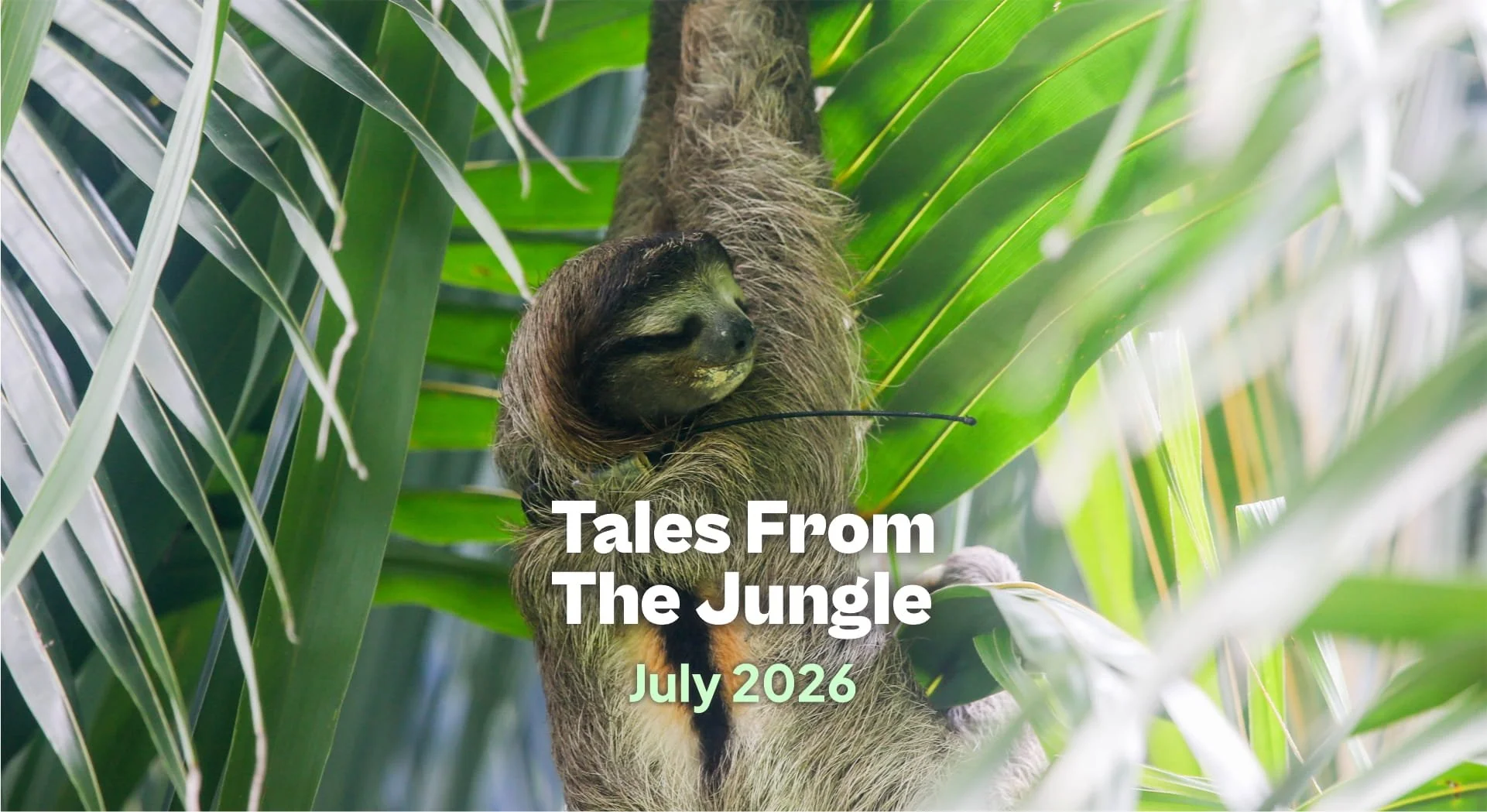
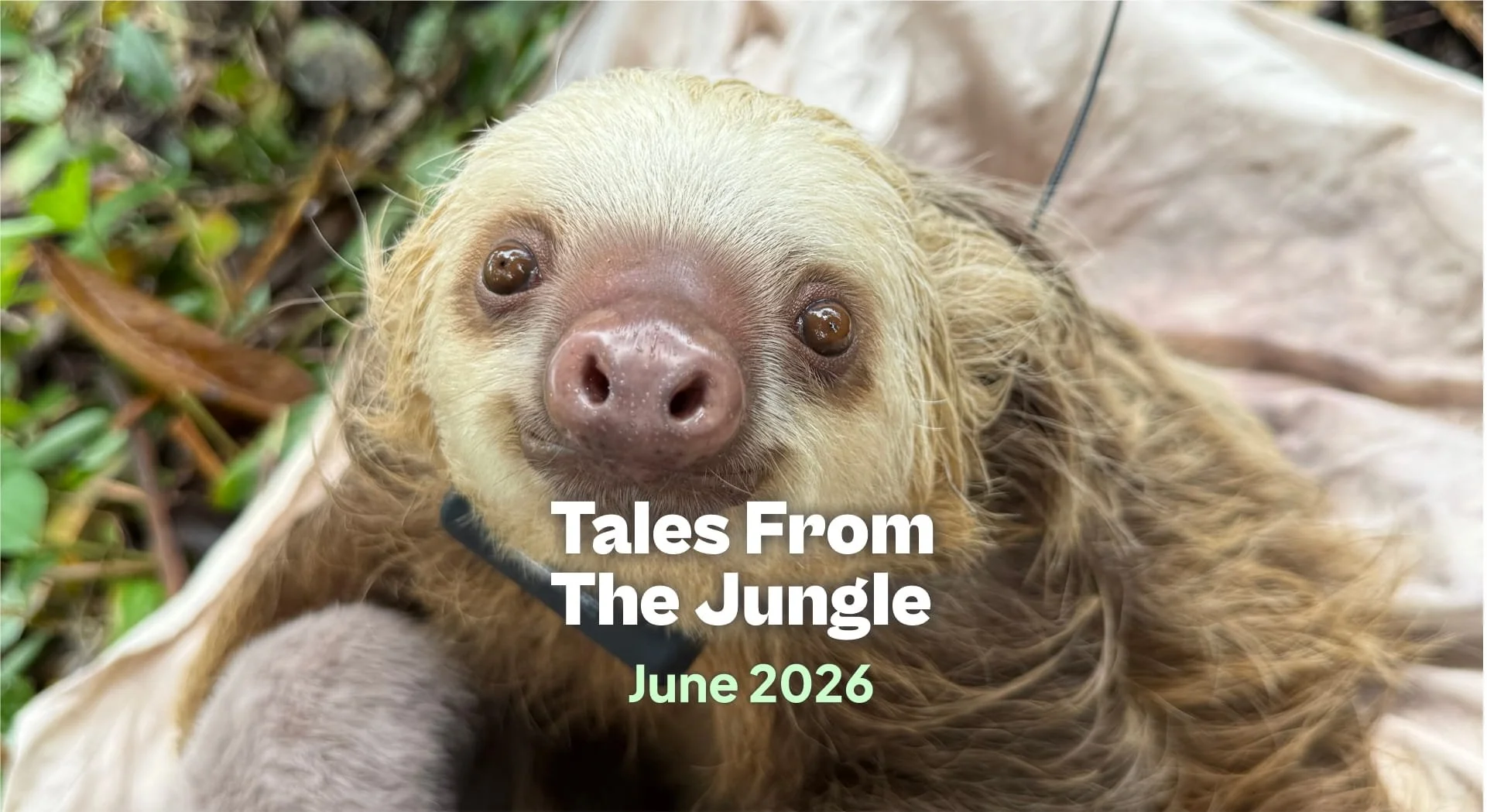
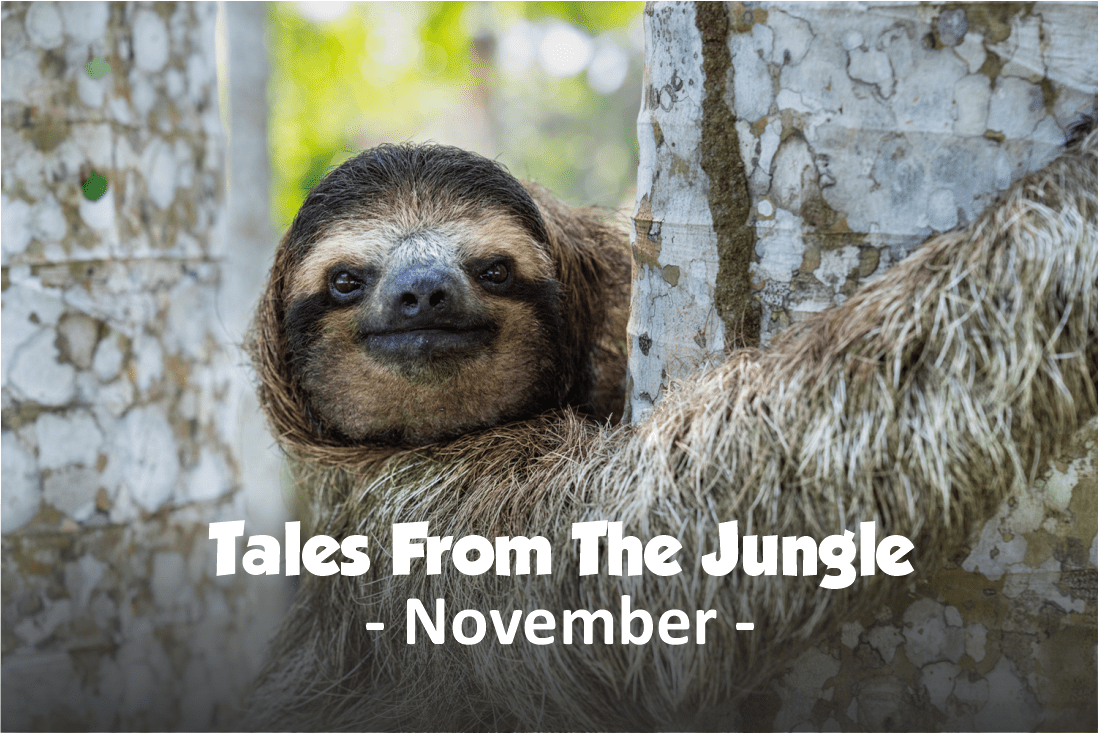
New sloths, new bridges, progress in Florida, and plenty of muddy adventures in the rainforest. Catch up on everything Team Sloth accomplished this June in our latest Tales from the Jungle.
It feels like we have lived through about six months in the space of four weeks. But before anything else, let’s start with what is probably the biggest news of the decade for sloths.
April is usually a quieter month here in the jungle - steady, predictable, and (relatively) calm. But not this time. It’s been a big month, and there’s a lot to share. But before we dive into everything, here are a few highlights to start.
From international stages to crawling through the forest looking for dropped collars, and a few very exciting new arrivals in our sloth family…
We’re delighted to share that our Connected Gardens project has been selected as one of three global finalists for the St Andrews Prize for the Environment!
Instead of easing into 2026, we seem to have launched straight into it at full speed. January came in with a bang, and the momentum shows no signs of slowing.
Welcome to the final stretch of 2025! Before we wrap up the year and share our full list of achievements, here’s everything that happened over the past month, and it’s a lot!
#SlothTober is coming to an end, and what a whirlwind it’s been! October is always one of our busiest months, and this year was no exception. Between International Sloth Day celebrations, travels, expos, and visitors (all while running our conservation projects as usual!), the jungle has been buzzing with activity.
Sloths and pandas are two beloved, yet vastly different animals from opposite sides of the world. Their uniqueness has captured the hearts of many, and their distinct appearance and quirky behavior have become symbols of nature’s diversity and resilience. Sloths are known for their slow pace and leisurely, arboreal lifestyle, while pandas are recognized for their black and white coats, clumsiness, and love for bamboo.
The rainforests of Central and South America are home to some of the most fascinating creatures on Earth, including sloths and howler monkeys.
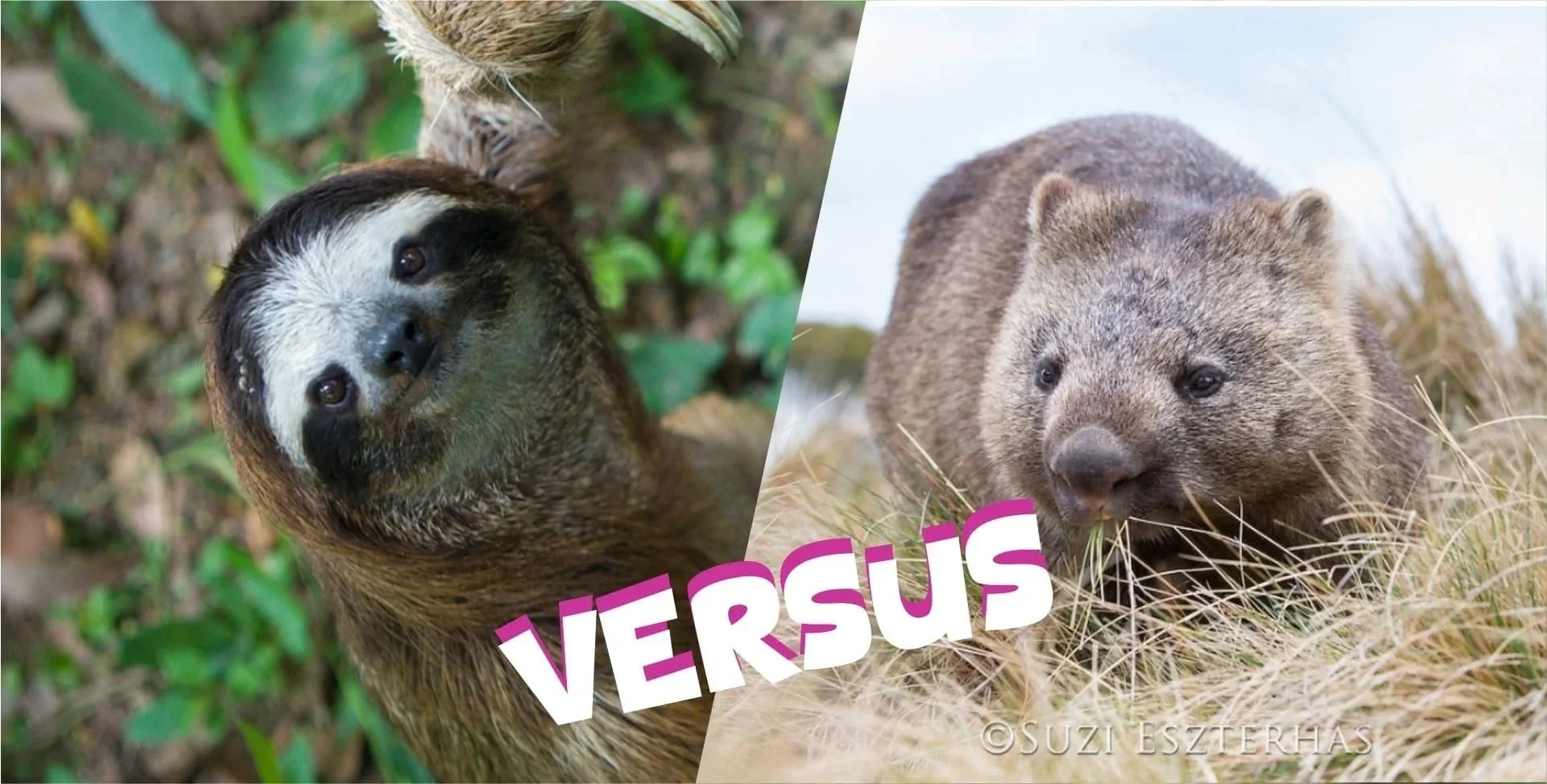
In the wild, some animals are just delightfully strange, which is the case with sloths and wombats. Sloths, with their slow lifestyles, seeming to live in a world where time barely exists, while wombats, with their chunky bodies and burrowing skills, are underground architects of the wild. In this blog, we’ll take a closer look at these quirky critters and see what makes them so fascinating and special.
The slow loris, or ‘loris perezoso’ in Spanish (literally ‘sloth loris’), is a fascinating creature. Despite living on the opposite side of the world from sloths, they share many similarities.
Finally, sloth bears! We seized the opportunity to compare sloths and sloth bears to clarify the confusion surrounding their common names and delve into their lifestyles, the threats they face, and ways we can help in their conservation!
Sloths and Sea Turtles couldn’t be more different animals. One is a furry mammal, and the other is an aquatic reptile. However, these two have more in common than we could think!
Do sloths and manatees have anything in common? One is a slow-moving arboreal mammal, and the other is a lumbering aquatic creature, so it’s hard to see the similarities at first. But let’s take a closer look and compare these two lovable, oddball animals. You’ll be surprised by a unique feature they share!
Wait — we’re comparing a sloth with a reptile? It’s never been done before! What could a sloth possibly have in common with a reptile? On the face of it, there’s not much that a warm-blooded sloth could share with a cold-blooded reptile. But these slow and charismatic creatures might be more similar than you’d think.
The sloth and the capybara, do they have anything in common? What is a capybara, anyway? Aren’t they, like, exotic-looking giant rats?
This month we’ve got another weird one for you as we compare the world’s tallest mammal with the world’s slowest: yes, that’s right, we bring you Sloths vs Giraffes!
In today’s edition of “Sloths vs” we bring you the final, the long-awaited, the last but never least of the Xenarthran Superorder, the armadillo!
Ready! Get set! Go….odbye! It’s a good thing this isn’t a race, because if it were, it wouldn’t be much of a contest between the slowest mammal and the fastest; after all, the sloth is outpaced by some species of plants, whereas the cheetah travels at speeds only matched by humans on the freeway.
Welcome to the latest version of “Sloths Versus”, your monthly introduction to strange creatures of all kinds, where we (virtually) travel around the world to find out that sloths are indeed one of the weirdest animals out there. In this edition we bring you… the aardvark!
Not to be confused with the giant panda, the red panda (Ailurus fulgens) is a small, furry mammal slightly larger than a house cat and completely unrelated to sloths. Red pandas are slightly more related to giant pandas than they are to sloths: the giant and red pandas parted ways just over 30 million years ago… about the time two- and three-fingered sloths diverged.
The humble sloth vs the armored pangolin, what have these two unusual mammals got in common? Pangolins are sometimes called “scaly anteaters”, because they A) have scales, and B) eat ants. If you remember our Sloth vs Anteater blog, you may be tempted to think the pangolins, like the furry anteaters, are distant cousins of the sloths, but in fact, they aren’t very related at all.
In this episode of “sloths vs” we are taking a look at another member of the Xenarthra; the anteater. Anteaters are in fact the sloth’s closest living relative, though by “close” we don’t actually mean very close.
The sloth and the snow leopard (Panthera uncia) seem like two animals that have absolutely nothing in common. After all, they live on opposite sides of the planet from each other, prefer habitats that couldn’t be more different without being under water, and one is a small herbivore that eats leaves while the other is a large predator that eats whatever it wants.
September 26th is ‘Save the Koala Day’ and here at the Sloth Conservation Foundation we want to celebrate by sharing some of the differences and similarities between these marvelous marsupials and our beloved sloths.
From the trees above a busy beach cantina to the edges of the urban forest, Tender’s life gave us a rare glimpse into how sloths grow, move, and adapt in human-shaped landscapes. This is the story of a gentle sloth, the community that surrounded him, and the lessons he left behind.
Trees, more trees. Ten, a hundred, a thousand, more?! The beginning of the Great Sloth Census (a different research project SloCo is conducting to study the population of sloths) is definitely not easy.
While strolling back from the beach one afternoon, I noticed a bunch of people standing by the side of the road, their necks craned upwards towards a tree that they were staring at intently.
“July was my first serious month of volunteering, as I was still learning in June. I enjoyed feeling more confident in my sloth-tracking abilities and becoming more familiar with the area.
Hello! I’m Faith, a student from the UK, currently doing a 12-month research placement with the Sloth Conservation Foundation working towards my degree in Zoology. Believe it or not I came across SloCo while online shopping. I was looking at a sustainable clothing brand that donates to several wildlife charities to aid conservation efforts, one of them being SloCo.
I have been working as a researcher for SloCo for only 7 months. The time has passed extremely fast, and still, I have learned incredible things that can only be taught in the field, working with people face to face and always improving my skills, not only my knowledge as a scientist but improving my second language which is English (people say I can speak good but I know I can get better at it).
“Ow! Ow, ow ow owwwwch!” I crouch down and hold my head in my hands, my skull still ringing with the impact. I feel as though I’ve been clonked with a falling coconut, or perhaps a rogue meteorite, though on some level I know that if this were the case I’d be far less conscious right now.
The sea breeze is a welcome relief as we crest the final switchback and come out on top of the cliff. I take off my hat and let the wind run through my hair. It’s too hot to dry us out much, but the view from up here is my favorite in all of Puerto Viejo: the seething white and blue waves beneath us, the mist-shrouded distant horizon, and the sunlit local Cocles Island.
“Oh look, barbed wire,” Becky says as she picks her way around the rusty tangle in front of her. “It’s my favorite.” “Are you sure?” I ask. “We have a busted sewer pipe over here.” “That’s my special favorite,” Becky assures me.
I stare at the spider hanging in front of my face. It is huge, blue and black and yellow, hanging from a golden web longer than my bicycle and better constructed than my house. It stares back at me.
I’m standing amongst the wreckage of felled trees and bulldozed undergrowth, my boots crunching on dead vegetation, but I’m not looking down.
I stare at the low chair in my living room, which I would swear on anything you like contained an orange backpack full of specialized sloth tracking equipment the last time I saw it. It is now empty.
“Dear Santa, This year I have been extremely very mostly good, and for Christmas, I would really like for a sloth to go poop.”
“Oh great,” says Dr. Cliffe. “I have poop in my boot.”
“Don’t you mean ON your boot?” says Amelia, using a machete to get through a two-meter-long spider web.
“Nope,” says Dr. Cliffe. “It’s dribbled down. And it belongs to someone else.”
Boys and girls of every age, Wouldn’t you like to see something strange? Come with us and you will see, Some weird things out while sloth tracking!
“I don’t even know what’s real anymore!” Amanda wails. We are tracking a sloth named Alan through the Cacao Forest, which I am thinking of renaming the Fairy Forest, because the lack of visibility and the way the radio signals bounce around is truly otherworldly. Also, the Bermuda Triangle is already taken.
They say that looking at trees can improve your mood. Merely being in the presence of these grand monuments of nature is credited with boosting the immune system, lowering blood pressure, lowering stress, accelerating recovery from injury, even increasing altruistic tendencies and curing ADHD.
I cling to a chain-link fence, the strap of the radio receiver clenched between my teeth as I climb sideways over an open ditch. It is clear from the smell that the local neighborhood has not gotten on board with the whole septic system plan.
“Oh my gosh,” says my boss, holding the binoculars to her face. “I think Croissant is a boy.” I take my eyes off the beeping box attached to our portable radio antenna and peer into the trees, trying to find the small, tan-colored sloth amongst the palm fronts and tree bark. Boy or girl, I personally think Croissant might actually be a coconut, but I defer to Amelia’s experience.
Three days of wildlife conservation, music, art, and community at the 3rd International Sloth Festival in Puerto Viejo, Costa Rica.
Sloths are more than fascinating rainforest animals. They have become symbols of strength, hope, and resilience for people around the world.
Costa Rica has taken a major step for wildlife conservation by making ecological connectivity part of infrastructure planning.
When we think about the loss of forests, we usually imagine clear-cut deforestation. But across Latin America, another kind of forest loss is also happening…
At the recent CITES COP20 summit in December 2025, the proposal to list two-fingered sloths in CITES Appendix II was adopted, in response to growing concerns about illegal trade driven by the rising demand for selfies and other wildlife attractions.
We’re thrilled to share that SloCo’s work, featuring Dr. Rebecca Cliffe and our Project Manager Tamara, is highlighted in the latest episode of In Her Nature, a PBS documentary series.
Gregarious animals, or animals that live in groups, often have unique collective nouns to refer to them. For example, a group of flamingos is called a flamboyance, while a group of owls is known as a parliament. You may have also heard of a conspiracy of ravens or a murder of crows. But what about sloths?
If you’ve been following our work for a while, you already know that finding sloths in the most unnatural places here in the South Caribbean is something we encounter almost every day. While it may seem delightful for tourists and appear ‘picturesque’ to see a sloth above a restaurant’s dinner table, it highlights the serious issue of urbanization encroaching on sloth habitats.
On July 25, the founder and executive director of The Sloth Conservation Foundation, Dr. Rebecca Cliffe, was awarded the honorary title of ‘Doctor of Science’ by Swansea University in Wales, in recognition of her groundbreaking work in research and conservation.
Young people always talk about what they want to be when they are older. Maybe they want to be a journalist, a baker, a dentist, or even a boss of a huge company. There are so many options!
February is the perfect time to celebrate love, and also love to sloths. It’s Sloth Love Month! You might wonder, do sloths love?
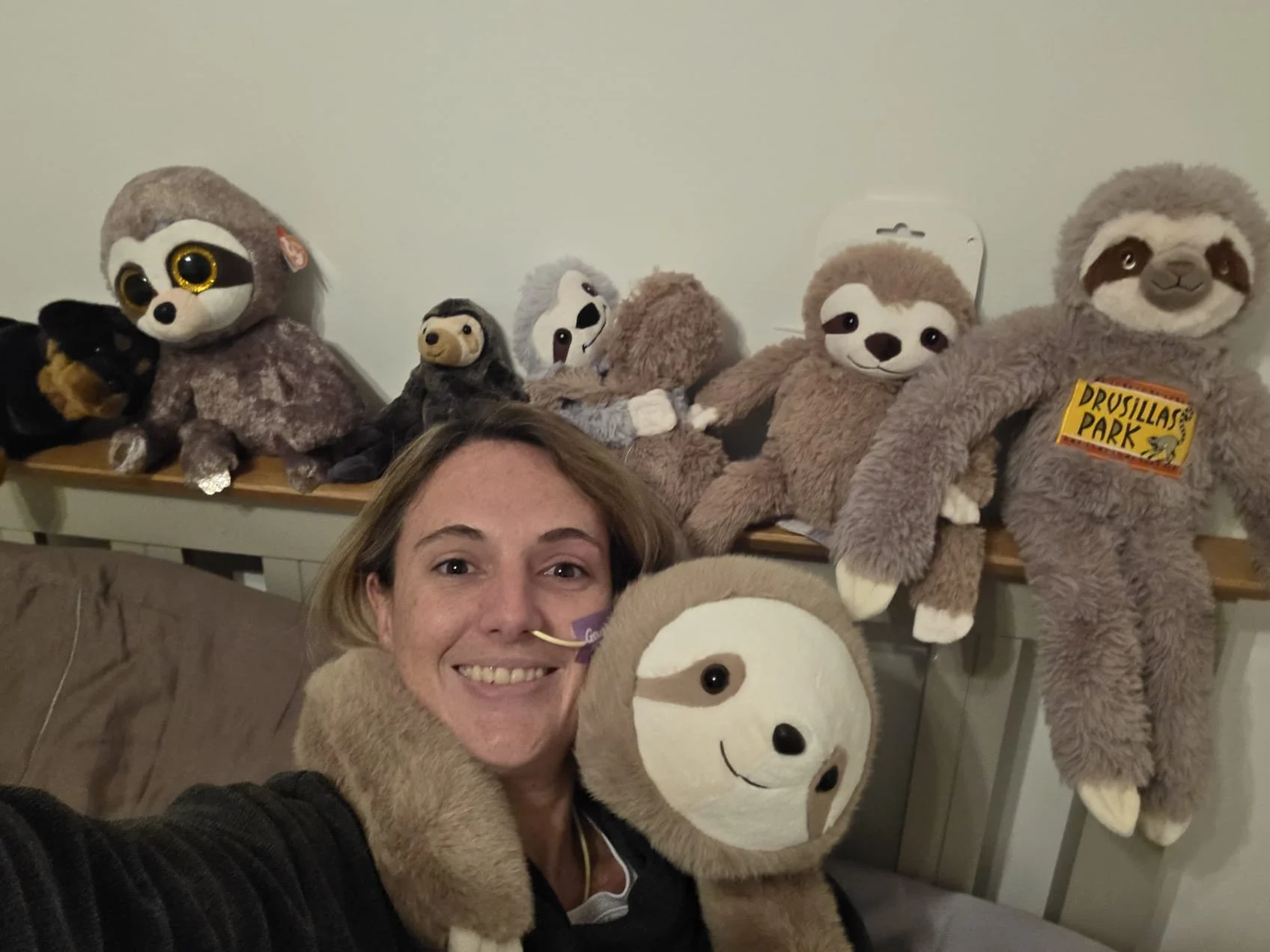
In the first week of December, we received the visit of our colleagues from Drusillas Park, Tamara and Gemma, who traveled from the UK to Costa Rica to deliver a donation to SloCo, after a fundraiser they held for #InternationalSlothDay back in October.
From Crops to Sloths: The Sweeping Impact of Crazy Ants Costa Rica has a problem, a crazy ant problem!
Last year we launched the first-ever International Sloth Festival. In spite of some rough beginnings and the remnants of Covid restrictions, we had a lot more people than we expected and the event itself was awesome!
The Kukula Kids’ Club, a new initiative for The Sloth Conservation Foundation, aims to enable and empower children with additional educational classes, gain new skills through workshops and provide them with fun activities they may not usually have access to due to geographical or financial barriers.
Since 1964 the International Union for Conservation of Nature (IUCN) has kept a list of the world’s most threatened species. This Red List of threatened species has since become the go-to authority for the status of Earth’s flora and fauna, serving as a critical indicator of our world’s biodiversity.
As a conservationist, I find myself thinking a lot about the word “diversity”. Concerning nature, the word is “biodiversity”, and we use it as a proxy for the health of ecosystems.
Welcome to Sloth Town, Puerto Viejo de Talamanca, a brightly colored surf town in the South Caribbean of Costa Rica. In Puerto Viejo, it is not uncommon to find sloths awkwardly climbing along fences or under the eaves, hanging out in bars, and generally making themselves at home.
The Future For Nature Foundation (FFN) supports promising young conservationists committed to protecting animals and plants in the wild. Each year the FFN Foundation chooses several candidates from a new generation of nature conservationists who are making a difference for the future of our natural world.
March 8th is International Women’s Day, when the world takes a moment to step back and commemorate the achievements, and activism of women.
Well, it’s been a year, hasn’t it? Just when we thought we’d be getting back to normal after 2020, it turns out there is no new normal! If you are still trying to find your footing in this world going forward, know that you are not alone.
Conserving riparian habitat (habitat near rivers, streams and lakes) is a key element in the protection of terrestrial and marine habitats, since these ecosystems are closely connected.
The Urban Sloth Project is an ongoing, long-term investigation into the impacts of habitat disturbance and rainforest urbanization on wild sloths in Costa Rica. Over the past five years, we have monitored 32 wild sloths using advanced tracking technology and micro data loggers – and we are adding new sloths to the project every month.
These two sloths are not only different species, but they belong to two completely different families, separated by over 30 million years of evolution. Cross-species adoptions like this are incredibly rare in the wild, with only 3 other documented observations of this happening.
July is plastic-free month. It is an opportunity to reflect on how we can reduce our plastic consumption, which not only harms our marine and terrestrial ecosystems but threatens our health as well.
This video of a three-fingered sloth using a wildlife bridge is the exciting result of the coordinated efforts of many people. We installed a Sloth Crossing for her and she started using it in record time (less than a month!).
One of the things that I love most about the rainforest is its otherness – trees that stretch into the sky, hosting worlds of life that I may only glimpse from a distance. Entering the forest is a humbling experience, it reminds me of the vastness and diversity of life on this planet and how much there is yet to be seen.
In stores and supermarkets in North America and Europe, you can buy a pineapple for just a couple of dollars. But what is the real cost behind that cheap price?
As a child, upon hearing that there is an increase in “desertification” worldwide I probably would have been overjoyed, imagining molten brownies and ice cream sundaes overflowing with chocolate syrup. But desertification (with one “s” instead of two), unfortunately, does not consist of a surplus of desserts.
You might find them both featured in baby animal calendars or filling the feeds of animal aficionados. But the lives of these two animals are entangled not just because of their comparable cuteness.
It is an unnerving time. The world watches with baited breath as the coronavirus outbreak continues to spread and social distancing becomes the norm. Doubts about the stability of the future and concerns for our loved ones press on our mind making it difficult to think clearly.
World Wildlife Day is the most important global annual event dedicated to wildlife. On the 3rd of March in 1973 the Convention on International Trade in Endangered Species of Wild Fauna and Flora (CITES) was born.
Do you ever smile when you are anxious? Laugh when you feel uncomfortable? Often, our external appearances can be deceiving.
Animals all over the world are being exploited for hands-on wildlife encounters. We might think that a photo of us riding an elephant, swimming with a dolphin – or holding a sloth – will impress our friends and family.
Here we detail the 7 biggest threats to wild sloth populations and explain what we are doing to help. In all cases, the best approach is through the development of long-term conservation solutions that provide sustainable ways for sloths to coexist with the people sharing their habitat.
This month we are delighted to have installed 2 new Sloth Crossing wildlife bridges in the South Caribbean region of Costa Rica!
Why do scientists sometimes feel the need to jump to extra conclusions, just so that they can have an eye-catching story for the media?
The world is waking up to the palm oil crisis that has driven orangutans to the brink of extinction, but is boycotting palm oil really the answer? Unfortunately no, but that doesn’t mean that we are powerless.
If you want to see sloths in the wild, a quick google search will definitively point you in the direction of Costa Rica.
For many species, the construction of a road slicing through the forest is an unwelcome inconvenience. Animals that can leap, such as monkeys, may be able to traverse the gap in the forest canopy without too much difficulty.
When asked what animal he would choose to be, Sir David Attenborough said he would undoubtedly be a sloth.
This guide will help you confidently identify and report concerns regarding captive wildlife and exotic animals.
One afternoon, Camila went for a walk with her dog Bahia and a dog she is currently training, Paco, who needs socialization.
It’s April 22nd, Earth Day, although we believe all days are Earth Day. We don’t want to write another blog about the importance of having a livable planet.
We venture outside to work on our field projects daily, armed with binoculars, necessary equipment, and appropriate clothing (especially during the rainy season).
#GivingTuesday was created in 2012 and aims to be an antidote to consumer culture by celebrating generosity and inspiring people to bring about change in their communities and the world. It’s a chance to promote causes you believe in, and the one day of the year when non-profit organizations and charities get a chance to take center stage.
Deforestation to make way for cattle farming is a problem growing as exponentially as the human population. Cows make a lot of methane as part of their digestion process, and so instead of forests full of trees making breathable oxygen, you get feedlots full of cattle making greenhouse gasses.
To expand into new territories and look for mates or food. It isn’t hard to imagine why animals need to move around, but when you work in conservation, the more interesting question is: how?
‘Meat out day’ encourages you to think about your meat consumption. Sloths have evolved over millions of years eating a purely leaf-based diet. Nowadays many people are opting to switch to more plant-based diets, but apart from the obvious ethical reasons, why are people choosing to go meat-free?
Giving Tuesday is finally here and the festive season is just around the corner (doesn’t it feel like 2020 has somehow been both the fastest and the slowest year ever?). We would like to take this opportunity to thank you for supporting us throughout this difficult time.
Look no further for sloth gift ideas – we have you covered! Our selection of sloth-themed Gifts that Give Back are available for international delivery and with proceeds going to support our sloth conservation efforts – it’s a double win.
Let’s be honest – 2020 is turning out to be an extra-ordinary year for all of the wrong reasons. It has been mentally and financially tough for individuals and organizations everywhere. Now, more than ever before, it feels like we are all just ‘hanging in there’ until life can get back to normal.
When it comes to tourism, sloths often get the short end of the stick. Sloths are at the top of the list of animals sought after for wildlife selfies. Due to their “celebrity status” they are often crowded by adoring fans and in extreme cases used as photo props for tourists.
Happy International Dog day everyone! While there seems to be a day for quite literally everything right now, a day dedicated to celebrating dogs is something that is pretty important to many of us! And it makes sense that the Day of the Dog is at the end of summer.
July is plastic-free month. It is an opportunity to reflect on how we can reduce our plastic consumption, which not only harms our marine and terrestrial ecosystems but threatens our health as well.
You may have heard of or remember a time when milk was delivered in glass bottles to your doorstep. In the span of a lifetime (80 years), we have gone from reusing and repairing most of our possessions to one where disposable products are the norm.
There comes a point in childhood when we begin to understand the concept of finite resources. The oft-used phrase, “you can’t have your cake and eat it too” captures the idea that we often have to choose between the things that we love.
This video of a three-fingered sloth using a wildlife bridge is the exciting result of the coordinated efforts of many people. We installed a Sloth Crossing for her and she started using it in record time (less than a month!).
You might find them both featured in baby animal calendars or filling the feeds of animal aficionados. But the lives of these two animals are entangled not just because of their comparable cuteness.
Have you ever considered that what you choose to eat each day has a direct impact on the welfare and survival of sloths in the wild?
What 35 million years of evolution reveal about resilience, extinction, and the role of humans.
In a recently published investigation called “Pre–Younger Dryas megafaunal extirpation at Rancho La Brea linked to fire-driven state shift,” Frank O’Keefe from Marshall University and his research team unfold the factors behind the disappearance of enormous prehistoric creatures in Southern California.
Researchers have discovered the remains of a specimen of Thalassocnus, a marine sloth found for the first time in a continental environment in Northern Argentina. This discovery significantly expands the geographic distribution of this lineage of fossil sloths.
For a chance to picture what the prehistoric Shasta ground sloth may have looked like, virtual and augmented reality may be our best bet. Ice Age giants such as mammoths, mastodons, giant beavers, saber-toothed cats, and dire wolves once roamed the American continent with giant ground sloths. But around 10,000 years ago, after the end of the last Ice Age, America’s impressive megafauna went extinct.
In the Amazon rainforests in the country of Colombia, there is a place called Serranía La Lindosa, with rock cliffs decorated in ancient drawings. There are thousands of paintings covering 12 kilometers (8 miles) of rock in an area that has been largely inaccessible.
Sloths these days are small, tree-dwelling animals that live high up in the rainforest canopy and do a good imitation of the plants they eat. They’re slow, they’re green, and they can’t jump—but a new study published in the journal Scientific Reports suggests their ancestors weren’t the strict vegetarians their reputation would have us believe.
“We believe that human beings are mainly responsible for the extinction of megafauna in South America,” said Luciano Prates and Ivan Perez, CONICET researchers at the Faculty of Natural Sciences and Museum of the National University of La Plata, Argentina, and authors of a scientific study on the matter, which is published in the journal Nature communications.
Argentinian scientists used X-rays on a 13,000-year-old sloth skin and discovered thousands of tiny bones on the inside.
Thirteen million years ago, when giant ground sloths roamed the Earth, a vast wetland known as the Pebas Mega-Wetland System extended across northernwestern South America.
Although it was on display for a long time at the Museum of La Plata, Argentina, its age was uncertain. A new study indicates that giant ground sloths lived 13,000 years ago and coexisted with the first humans of South America.
Did you know that we can thank giant ground sloths for the avocados we have today? Giant ground sloths were one of the few ancient herbivores large enough to swallow avocados whole, thus serving as an important seed disperser for these delicious fruits that we know and love today!
A giant sloth weighing five tons and whose height could exceed twice that of a human being was part of prehistoric Costa Rica seven million years ago.
When asked what animal he would choose to be, Sir David Attenborough said he would undoubtedly be a sloth.
Today we celebrate books! April 23rd is International Book Day, in honor of two of the most important writers in history: William Shakespeare and Miguel de Cervantes.
To celebrate the International Day of Human Spaceflight, held every April 12th, we're reaching for the stars with a little help from one of our most stellar supporters: Ponder E. Stine.
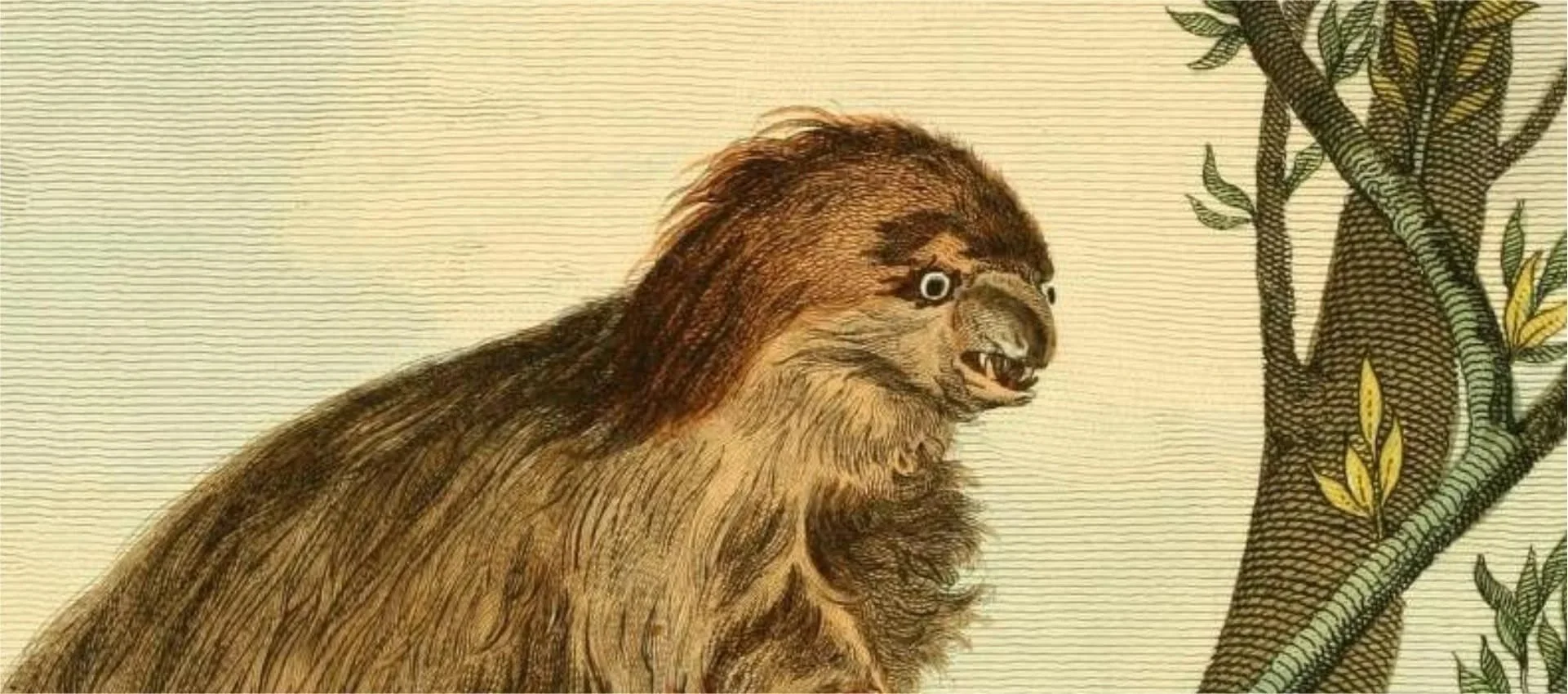
Well, since these illustrations date from the 1700s to the 1800s, they technically represent ‘Enlightenment’ or ‘Victorian’ sloths, as those are the historical periods often associated with these centuries. But let’s not get too scientific for the sake of a good old-fashioned meme!
Although often referred to as two-toed sloths, this description can be a bit misleading since all sloths have three toes on their hind limbs. The real difference lies in their forelimbs, where sloths in the Choloepus genus have two fingers.
The definitive quiz and trivia for sloth experts! This time, we have the three-fingered sloth edition to celebrate the Bradypus genus. Don’t be fooled by the first question—it’s just an easy one to get you warmed up!
Ur-Song Music is proud to donate “You Call Me Slow (The Sloth Song)” to SloCo. It’s a lighthearted, Broadway-style ballad that invites listeners to slow down and enjoy grooving at the speed of sloth.
Today is International Workers’ Day. And what does this have to do with sloths? First, it makes us think about the unfair name of these animals, a form of the word ‘lazy’ in most languages. But even though sloths are not lazy but energy-efficient, it also makes us think about laziness and how in our societies’ overfall, being a little bit idle and slowing down is not permitted. If you have today off, you are probably feeling guilty about it.
THE 19th-century French poet Gérard de Nerval used to take his pet lobster for walks in Paris at the end of a silk ribbon. Asked why he was so fond of this animal, he replied: “I have a liking for lobsters. They are peaceful, serious creatures. They know the secrets of the sea and they don’t bark.”
Last year we launched the first-ever International Sloth Festival. In spite of some rough beginnings and the remnants of Covid restrictions, we had a lot more people than we expected and the event itself was awesome!
Why are sloths so darn cute? Is it the little button eyes, the round, fuzzy head, or perhaps the adorable pink tongue? Whatever it is, there’s no denying it: sloths are so cute they just make your heart melt.
Supporters, how do I love thee? Oh, let me count the ways! I love your Urban Tracking Team, that finds me every day. I love you for your green-roped bridges that connect the canopy, I love you for your camera traps that take pictures of me!
Off the Caribbean breeze, there’s a sloth called Kokomo. He’s where we wanna go, to get away from it all.
Some experts consider memes an important form of communication. No doubt you also know someone who speaks in memes (millennials, we’re looking at you) and we love memes too!
It’s the end of the year again—time to reflect, reorganize, and recap the best of 2021. So here are our top 10 blogs, articles, photos, and stories.
Boys and girls of every age, Wouldn’t you like to see something strange? Come with us and you will see, Some weird things out while sloth tracking!
GREAT excitement has followed my discovery, in an attic clean-out at Beachcomber Towers, of a manuscript believed lost for more than 2,000 years. Written by the ancient Greek philosopher Arislothl, it is nothing less than a complete version of his legendary masterpiece Lethargics outlining his highly influential views on the merits of nothingness.
Recently we visited Costa Rica’s La Salle Museum of Natural History, located in the capital, San José. With over 65,000 specimens on exhibition, this is one of the most complete collections in Latin America.
At its heart, Valentine’s Day is an opportunity to show appreciation for our loved ones. Showering our significant others with shiny boxes of sticky chocolate, heart-shaped candies, and love-struck teddy bears: we share gifts to demonstrate our affection for them.
With a following rivaling that of the Kardashians, these baby sloths will never know just how famous they have become.
When you think of Halloween, sloths may not be the first creatures that come to mind. These “serial chillers” may not immediately strike fear in the hearts of children but have you ever seen a sloth creeping around at night?
Planning a wildlife trip? Learn how to identify ethical wildlife tours, avoid harmful practices, and support responsible tourism that protects animals and their habitats.
Maned sloth tourism contributes millions to the local economy, creates jobs, and demonstrates that forest conservation is a smart economic investment.
Puerto Viejo de Talamanca: the beach town where the dress code is a bathing suit and flip-flops and no one is in a rush to go anywhere. It has more than paradise beaches, and in this list, we’ve selected for you the very best things to do in our little corner of the South Caribbean. Trust us, we did them all!
“Limón has its own identity,” said Markus Brown, whose family has lived in Punta Uva, one of the most beautiful beaches in the world, for more than a century.
Responsible travel is not only caring about nature and the ecosystem, it is about being socially and culturally aware, understanding and respecting different cultures, customs, and traditions. It is about always trying to have a positive impact and minimize the negative impact as much as possible.
Recently we visited Costa Rica’s La Salle Museum of Natural History, located in the capital, San José. With over 65,000 specimens on exhibition, this is one of the most complete collections in Latin America.
When it comes to tourism, sloths often get the short end of the stick. Sloths are at the top of the list of animals sought after for wildlife selfies. Due to their “celebrity status” they are often crowded by adoring fans and in extreme cases used as photo props for tourists.
Are you thinking about booking a sloth encounter experience at a zoo or rescue center? Before you book, follow our simple guide below to make sure you don’t get tricked into supporting an organization that causes harm to the sloths in its care.
Would you like to have your photograph taken with a sloth? A sloth selfie for social media? When considering a sloth encounter, the most important thing to remember is the slogan of the year: social distancing!
It is an unnerving time. The world watches with baited breath as the coronavirus outbreak continues to spread and social distancing becomes the norm. Doubts about the stability of the future and concerns for our loved ones press on our mind making it difficult to think clearly.
Do you ever smile when you are anxious? Laugh when you feel uncomfortable? Often, our external appearances can be deceiving.
Animals all over the world are being exploited for hands-on wildlife encounters. We might think that a photo of us riding an elephant, swimming with a dolphin – or holding a sloth – will impress our friends and family.
The tourism industry is a huge business. By 2020 it is estimated that 1.5 billion people will be traveling the globe as tourists, but here we want to highlight a particular trend that is rapidly growing in popularity; ecotourism.
We are so excited to launch our latest campaign in 2019 – how to enjoy sloths without stressing them out, a guide to responsible sloth tourism!
If you want to see sloths in the wild, a quick google search will definitively point you in the direction of Costa Rica.
A while ago, the internet went crazy over the story of a five-month-old baby girl and her best friend: a pet sloth.
When it comes to tourism, sloths often get the short end of the stick. Sloths are at the top of the list of animals sought after for wildlife selfies. Due to their “celebrity status” they are often crowded by adoring fans and in extreme cases used as photo props for tourists.
You may have heard of or remember a time when milk was delivered in glass bottles to your doorstep. In the span of a lifetime (80 years), we have gone from reusing and repairing most of our possessions to one where disposable products are the norm.
In stores and supermarkets in North America and Europe, you can buy a pineapple for just a couple of dollars. But what is the real cost behind that cheap price?
As a child, upon hearing that there is an increase in “desertification” worldwide I probably would have been overjoyed, imagining molten brownies and ice cream sundaes overflowing with chocolate syrup. But desertification (with one “s” instead of two), unfortunately, does not consist of a surplus of desserts.
World Wildlife Day is the most important global annual event dedicated to wildlife. On the 3rd of March in 1973 the Convention on International Trade in Endangered Species of Wild Fauna and Flora (CITES) was born.
Many people are drawn to Costa Rica for its “Pura Vida” lifestyle (literally translating as ‘Pure Life’); a motto that reminds people to stop and enjoy the richness of life, to take the time to sit down and savor a cup of coffee over a late-afternoon conversation.
We have created a list of 7 simple things that you can do every day to help sloths – all from the comfort of your own home!
Have you ever considered that what you choose to eat each day has a direct impact on the welfare and survival of sloths in the wild?
The world is waking up to the palm oil crisis that has driven orangutans to the brink of extinction, but is boycotting palm oil really the answer? Unfortunately no, but that doesn’t mean that we are powerless.
If you want to see sloths in the wild, a quick google search will definitively point you in the direction of Costa Rica.
José Pablo Guzmán García is our sloth scientist in charge of the Urban Sloth Project (USP)and is also involved in other research initiatives, such as the Great Sloth Census.
Last year Team Sloth were thrilled to receive an invite to visit the Tortuguero National Park on the Caribbean Coast of Costa Rica. Tortuguero is renowned as one of the most important turtle nesting sites in the whole world, and in particular, its white sand beaches are a haven for endangered green sea turtles.
Amelia Symeou is SloCo’s Ecology Coordinator. She is currently leading the Urban Sloth Project and tracking sloths every day. How did she become one of SloCo’s scientists? What’s a day in the life of a sloth scientist really like?
October 11th is International Day of the Girl. This is a day to recognize the issues that girls face globally and to break down barriers to their empowerment and success. This year the motto is “My voice, our equal future“: a call to action that emphasizes how the well-being of humanity and the planet depends upon the future of girls.
Happy International Dog day everyone! While there seems to be a day for quite literally everything right now, a day dedicated to celebrating dogs is something that is pretty important to many of us! And it makes sense that the Day of the Dog is at the end of summer.
To be a wildlife photographer you need to have a lot of patience: spending days on end out in the wilderness, going to extreme lengths to blend in with the surroundings, and a lot of waiting (usually in awkward positions) for the perfect shot. But being a sloth photographer requires a whole new level of patience.
Thank goodness for books! Especially in recent times they have become even more treasured and there’s so much we can gain from them! They can teach us, help us escape, take us on adventures, make us fall in love and so much more.
Cecilia, our communications officer, comes from the steppes in Patagonia, a dry, arid, windy, and cold landscape very far away from the hot, humid rainforests of Costa Rica. Her journey in conservation began with a bunch of photos of birds.
At the recent CITES COP20 summit in December 2025, the proposal to list two-fingered sloths in CITES Appendix II was adopted, in response to growing concerns about illegal trade driven by the rising demand for selfies and other wildlife attractions.
In the Amazon rainforests in the country of Colombia, there is a place called Serranía La Lindosa, with rock cliffs decorated in ancient drawings. There are thousands of paintings covering 12 kilometers (8 miles) of rock in an area that has been largely inaccessible.
Team Sloth contacted Jorge Carballo, the man responsible for the idea to declare sloths the national symbol for Costa Rica. Jorge grew surrounded by lush tropical forests and is passionate about nature.
July is always an eventful month for Team Sloth, but we weren’t prepared for what was lurking around the corner this year! Things got off to a good start as we celebrated an important symbolic achievement and a huge milestone for one of our projects.
National symbols are culturally created images to represent the country and preserve collective memories about these icons. Usually, these symbols include national anthems, flags, shields, animals, flowers, trees, national dishes, and languages.
June has been an emotional rollercoaster for Team Sloth. We sadly witnessed some of the most cruel, greedy, and reckless sides of humanity, but we also managed to achieve some fantastic breakthroughs for sloth conservation.
Last year Team Sloth were thrilled to receive an invite to visit the Tortuguero National Park on the Caribbean Coast of Costa Rica. Tortuguero is renowned as one of the most important turtle nesting sites in the whole world, and in particular, its white sand beaches are a haven for endangered green sea turtles.
Team Sloth have been the opposite of slothful this month – we have been chasing invisible sloths through the jungle, carrying out emergency surgeries, castrating dogs and we were shamefully outsmarted by a herd of hungry goats. Read on below to learn about our biggest successes and failures this month!
“We believe that human beings are mainly responsible for the extinction of megafauna in South America,” said Luciano Prates and Ivan Perez, CONICET researchers at the Faculty of Natural Sciences and Museum of the National University of La Plata, Argentina, and authors of a scientific study on the matter, which is published in the journal Nature communications.
Argentinian scientists used X-rays on a 13,000-year-old sloth skin and discovered thousands of tiny bones on the inside.